More about the treatment
Does the tooth need a filling yet?
Not every early sign of tooth decay needs a filling straight away. What matters is how far the damage extends and whether it is actively progressing. If a defect needs treatment, a filling can replace the missing tooth structure.
For a chipped tooth or a damaged existing filling, we also start by assessing which restoration is appropriate.
Which material is right for your tooth?
We discuss the possible materials, their advantages and disadvantages, and the costs. The size of the damage is not the only consideration: its location, the forces during chewing and the remaining tooth structure also matter.
- Composite: a tooth-coloured filling material placed directly in the tooth and shaped to fit it.
- Ceramic or gold: custom-made indirect fillings may be suitable for certain defects. An inlay fits within the tooth; an onlay also covers one or more of its cusps.
What happens during treatment?
After the examination, we explain the planned restoration and discuss local anaesthesia. The tooth is prepared for the chosen filling. When treating decay, the aim is to restore the damaged area while preserving as much viable tooth structure as possible.
A direct filling is shaped within the tooth. A custom-made inlay is fitted and secured in place. Finally, we check how your teeth meet when you bite.
What matters afterwards?
A filled tooth still needs thorough cleaning and regular check-ups. A filling does not permanently protect it against further decay. Its lifespan depends on factors including its size, the forces it is exposed to and how it is cared for.
Please contact us if your bite feels too high after treatment or if discomfort persists. We will check whether an adjustment or further assessment is needed.
Is a particular area worrying you?
Book an examination. If you have acute pain or have recently chipped a tooth, please call so we can assess the urgency with you.
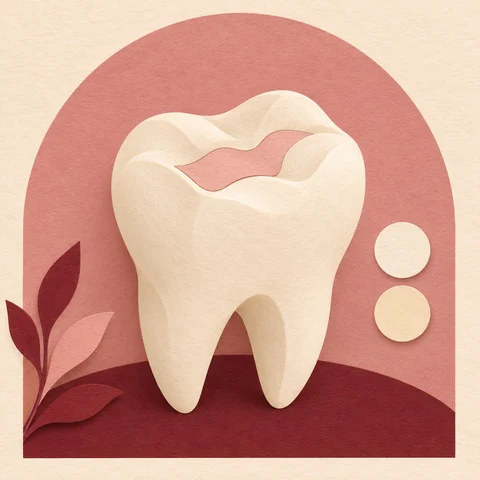
SCHEMATIC COMPARISON
A direct filling or a custom-made restoration?
Two ways to restore a tooth defect that needs treatment. An examination shows which option is suitable.
Direct filling
Composite, for example, is shaped within the prepared tooth and hardened there.
Inlay
A precisely fitting restoration, for example made of ceramic or gold, is made outside the tooth and then bonded or cemented in place.
The material and type of restoration depend, among other things, on the location and extent of the damage and the forces acting on it. The illustrations are not instructions for self-treatment.